
A Secret Weapon for the Holidays

I don’t know about you, but the end of daylight savings and the subsequent earlier than ever sunsets have got me feeling drowsy. All the time! Not to mention the fact that, at least here in New York, the weather can’t seem to make up its mind. Cold and rainy one day, mild and clear the next. It’s been putting a real damper on my spirits and draining me of my energy. So, not one to wallow, I’ve been seeking out assistance from one of very favorite product lines, Resvitale.

When ResVitale first burst on to the supplement scene its primary focus was resveratrol. It quickly expanded into the realm of cocoa and have a very well received CocoaWell line featuring pure organic cocoa (cacao) powder.
The line includes a 100% pure cocoa supplement- Cocoa, a heart tonic featuring coenzyme Q10- CocoaHeart Q10, and my current fav- Cocoa Energy Restore. Before I go into what makes this a supplement of choice, let me first pay homage to my dear sweet cocoa and all of its power and glory!

If you have not received the memo, cocoa is now a world recognized highly regarded super fruit; and a major source of its acclaim, the flavanol epicatechin, is so potent it has both the science and healing communities questioning whether or not it should be considered as essential to disease prevention as our current list of required vitamins and minerals. Epicatechin is the bitter component of dark chocolate that gives it its anti-oxidant power. Some other antioxidant nutrients found within natural cocoa are EGCG and catechins, green tea’s claim to fame. The super fruit’s many benefits include but are not limited to:

  1. Enhanced circulation
  2. Anti-Inflammation
  3. Anti-Oxidant Protection
  4. Mood Enhancement
  5. Improved mental alertness
  6. Increased cardiovascular health
  7. Reduced incidence of heart failure, cancer, diabetes and stroke
  8. Enhanced physical energy and muscle recovery

Now for the good stuff!
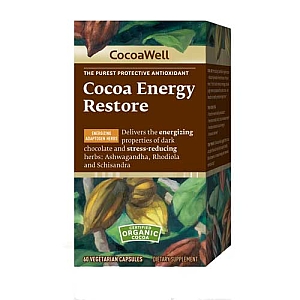
What I like most about the Cocoa Energy Restore-aside from the way it makes me feel-is not only does it include 350 mg of pure cocoa (that’s almost the antioxidant value of 100 grams of dark chocolate) per  serving, it also has 400 mg of green tea flavanols for added anti-oxidant protection plus three of the most potent adaptogens-  Ashwaganda, Rhodiola and Schisandra. As you may recall, adaptogenic herbs help our bodies adjust and better handle stress. As an added boost, Cocoa Energy Restore rounds its formulation off with pure tea extract providing a little over 140 mg of caffeine. These ingredients are all encased in a 100% vegetarian capsule that contains no corn, soy, gluten, dairy or fish products. So it’s safe for most diet restrictions. Unless of course you are allergic to chocolate! If so, I am so so sorry.

And it feels like…

Smooth sustainable energy, topped with a scoop of optimism, and sprinkled with an ounce or two of the “take it easies”. What better way to get through the shop frenzied, crowd weaving, gift wrapathoning, office partying, secret Santa-ing, quality time with the…  holidays that we so anticipate, savor and love? And for a limited time you can gift yourself with a two for one on the entire CocoaWell line! That’ll be the Zen sled that carries me through the New Year unperturbed and unscathed. But if supplementing isn’t your thing, feel free to dive into that cup of hot cocoa and make your favorite deserts as chocolatey as you can. Remember, the darker the better!

Til next week, indulge and BeWell!

Thankful for Food Euphoria

Giving thanks for the people, circumstances and opportunities in our lives is a necessary and often under-recognized component of wellness. Sharing loving sentiments and actions with others strengthens our sense of connection with the world and receiving this in return goes a long way in building our self-esteem. This is truly one of my favorite holidays and the meal that is shared…oh the meal… It is hands down my favorite of the year!

We all know how satisfying and stupefying the Thanksgiving menu can be, hence the almost guaranteed over indulgence. But many, myself included, may be underestimating how nutritionally potent this feast is. Here’s a brief breakdown of the basic items:

The headliner-Turkey is a wonderfully lean source of protein that the body digests relatively easily, unlike beef and pork. It provides a healthy supply of B vitamins and the amino acid L-tryptophan. L-tryptophan, with the aid of carbohydrates, increases brain serotonin levels and creates that calming sensation often experienced after the meal.

Cornbread stuffing or “dressing” as it’s called in my family has the makings of a genuine tonic. Cornmeal, especially when whole and un-milled, contains abundant amounts of an array of nutrients including fiber, amino acids, vitamins and minerals. Some highlights include:

  • B vitamins Niacin, Thiamine, Riboflavin, Pantothenic Acid and B6. Niacin increases food utilization and reduces cholesterol. Pantothenic Acid (B5) is known as the “anti-stress vitamin”
  • Antioxidant “Fat Pac” members Vitamin E and K to fight the signs of aging and aid calcium in strengthening our bones
  • Minerals Iron for blood building, Magnesium for relaxation of the musculoskeletal and nervous systems and Zinc and Selenium for immune system enhancement

Factor in the garlic, onions and peppers and you have a disease fighting power house. Allicin, found in both garlic and onions, is the active healing component that makes these herbs protective against ailments ranging from the common cold to cancer. Onions also contain the anti-inflammatory bioflavonoid Quercetin which makes for an effective and natural antihistamine. Bell peppers, especially red, contain phytonutrients that, through their ability to prevent blood clot formation,  provide a wide range of health benefits including reduced heart attack and stroke risks.

Those sweet, sweet, Sweet Potatoes…each 3ounce potato contains over 19,000 IUs of Vitamin A (compared to the US RDA of 10,000 IUs) and over 11,000 mcgs of carotenoids for added protection against inflammatory diseases like Rheumatoid Arthritis.

Now on to the greens, and whether it be Collards, Mustards, Spinach, Cabbage or

Steamed kale and slivered almonds
Image via Wikipedia

Kale, all contain heaping amounts of vitamins, minerals, phytonutrients  and fiber known to strengthen the body’s defenses against infections and viruses. Collards, cabbage, kale and other cruciferous vegetables also contain a unique chemical called Indole-3-carbinol that enhances DNA repair within the cells. It is thought to be specifically beneficial to cancers and diseases associated with hormonal abnormalities such as breast and prostate cancers and Lupus. Try first chopping or mincing and then steaming or stir frying these to bring out and preserve the most healing components of the greens.

And last but not least, the Cranberry Sauce! In addition to their widely known antioxidant potency, cranberries also have the unique ability to protect the urinary tract from bacterial infections. This mighty little berry helps prevent bacteria from sticking to the urinary tract wall. Cranberry juice concentrate and cranberry herb are included in most total body cleansers for this reason.

Now of course, the fresher the ingredients, the more nutritious the dish, and preparation certainly matters. Many of the above health benefits can be lost with cooking methods that over process the food or use a lot of saturated fat and cholesterol containing oils.

Quick tip: choose extra virgin olive and or coconut oils when possible for added flavor, healthier fats and lower cholesterol levels.

 I have my sister/friend/cousin K.G. to thank for this:

  • first lightly blanching kale in salted boiling water
  • then sauté in coconut oil

Absolutely delicious and vibrantly green!

Well folks that’s it for now, as I know the feasting will start soon. Eat up, enjoy and do so knowing that you’re not just indulging your palates but are also stacking your plates with some seriously potent nutrients.

Happy Thanksgiving and BeWell!

The Fat Pac: Allies, Enemies and Overkill

The Ancient Egyptians knew that feeding a pati...
Image via Wikipedia

Many of my clients and customers prefer to get their nutrients from food for  various reasons including their individual tolerances, concern for their other medications or simply their own prerogative. Above all, I support the individual pursuit of wellness and respect each person’s right to decide what works best for them. The following is for those still on the fence with nutritional supplements because of the
seemingly exhausting process involved in sifting through all the circulating information.

Does the body absorb everything in a single multivitamin?

What vitamins are best taken together and which ones should be taken alone?

Can I take too much, and will that make me sick?

These may be the simplest yet smartest questions to ask when contemplating a supplement plan. The first two are more straight forward than the last. So, you may need to take back the reins at that point, but the following breakdown should enlighten your way there. Let’s begin.

Allies, Enemies and Overkill-The Fat Pac

The typical multi vitamin, multi mineral supplement combines all of the essential nutrients in one formulation, providing the minimum recommended daily amount of each nutrient contained. There are vitamins that work better with and because of one another. These are said to have a “synergistic relationship” and can be taken together without interfering with one another’s work in the body.

On the other hand, there are nutrients that compete with one another for the body’s attention and interfere with each other’s absorption or uptake by the body. There are also other factors, both internal and external, that can impede on a nutrient’s ability to do its work. And sometimes, a vitamin can be its own worst enemy. The Fat Soluble Vitamins-A, D, E & K- are a perfect example. They are similar in that they are all transported through the body by our dietary fat and then stored (though some more than others) within our own body fat when not fully used at the time they’re taken.
Consequently, over supplementing them is not necessary or advised.

The widely accepted belief is that these are best utilized when taken before breakfast or bed. But they can be taken on either an empty stomach or following a fatty meal, and many authorities also recommend taking them separately from the Water Soluble
Vitamins
.

Vitamin

 Daily Needs

Sources

Alliances

Competitors

Toxicity

A 10,000 IUs Liver, Fish Liver, Carrots Vit.C & E help prevent the loss of stored Vit.A and Zinc is
needed to release the body’s stores
Excessive Iron intake More likely with synthetic A than Beta Carotene. Symptoms include
pressure headaches, nausea, dizziness, abdominal pain and hair loss.
D 800 mg Sunshine, Cod Liver Works best with Vit.A & sufficient Calcium and Phosphorus
(800mg/day)
Sunscreen More than 1000-1500 IUs/day for a month can cause diarrhea, headaches
and the hardening of the body’s soft tissues
E 400-800 IUs Vegetable, seed and nut oils Selenium (50-200 mcg) increases Vit.E’s potency Iron reduces the body’s absorption of E More than 1200 IUs may suppress the immune system
K 75-300 mcg Dark leafy greens, Alfalfa, Kelp Vit.K uses Potassium and Calcium to facilitate blood clotting within
the body
Too much E & Calcium can reduce K’s uptake Synthetic K3 can cause toxicity symptoms-sweating, flushing,
tightness of the chest- when the body does not eliminate the excess * toxicity is rare

A Little Food for Thought

  1. If your diet and lifestyle provide you with even moderate amounts of the Fat Pac, then you may want to supplement them on an as needed basis and focus more on their water-soluble and mineral allies for your every day program.
  2. You may also want to prioritize vitamin D and E during the fall and winter seasons.

Generally these seasons are less sunny than the spring and summer so our most abundant source of vitamin D is compromised.

Vitamin E is an important immune booster that can help prevent the onset of colds and flu. And, it isn’t stored by the body as much as the other fat soluble vitamins. So, toxicity is less likely.

That should do for now folks. Until next week…

Keep it Simple and BeWell!

Back to Basics

Lately I’ve been getting a lot of questions on the basics of supplementation. So, I thought it a good time to add to our FAQs. The following are just a few of the most commonly asked.

I eat lots of fruits and vegetables. Do I really need to take vitamins?

I envy those who somehow manage to get the recommended 5-9 servings of fruits and vegetables a day. So clearly, I am not one despite knowing and believing in the importance of this practice. I also lead a very hectic and at times stressful life that is made possible in part by my partaking of caffeine, an alcoholic bev here and there and, now that it is getting colder, those lovely decadent and forbiddingly rich foods. All reasons why I feel I need a vitamin supplement.

But if you are a relatively healthy person, not taking any medications, consuming limited amounts of caffeine and alcohol, not smoking and easily managing your current lifestyle and stress level, then supplementing additional nutrients is probably unnecessary.

Some other factors for consideration are whether you are a meat and/or fish eater or are strictly a vegetarian. There are some crucial nutrients such as Vitamins A and D that are most abundantly found in animal foods. Additionally unless you are eating most of your fruits and vegetables in their raw forms, you may not be getting all of the nutrients the plant foods have to offer.

Your doctor may know best on this one, and should tell you when you are deficient in any vitamins or minerals. And, supplementation doesn’t have to be a long-term commitment. You may find that it is only appropriate for you at certain times such as a change in seasons, busier and more stressful times like the holidays, or when you feel the onset of a cold or other ailment. You may also find that during these times it’s not all of the vitamins you need to supplement but just a few like A, C and E for immune support.

What is meant by the terms “fat and water-soluble” and what difference do they make with vitamins?

Our basic vitamins are broken into two categories-fat soluble and water-soluble. The fat soluble ones- A, D, E and K-are found within the lipids (fat) of plants and animals. They are transported from our food to our bodies by essential, healthy dietary fats where they can be stored in our own body fat for future use. Because our bodies generally maintain a reserve of the fat soluble vitamins, over supplementation of them without doctor’s direction, consent and supervision is neither necessary nor healthy, especially over extended periods of time. These vitamins may be taken with or without food; but they are best taken before breakfast and/or before bed. You can also take them following a meal containing fatty foods. And although some experts recommend taking them separately from the water-soluble ones, the jury is still out. Some of the fat soluble vitamins even work better when taken with the water-soluble ones, namely A, C and E.

Water soluble vitamins-the B Family and Vitamin C- are found mostly in raw fruits and vegetables, don’t stand up well to heat and other forms of food processing and, in this way, are less stable than fat soluble vitamins.  The water-soluble vitamins are not abundantly stored in the body. It easily excretes what it does not need of these. This means we need to maintain a consistent daily intake of them and can generally take them in doses well over the recommended daily allowance without doing harm. The water-soluble vitamins are also best taken with food because they need to be dissolved and digested to be used by the body.

What’s the best way to take my vitamins-pills, powders or liquid?

This really depends on your individual system, more specifically your digestive system. But generally speaking the body has an easier time breaking down and absorbing powders and liquids than it does hard tablets. Many experts doubt even a strong digestive system’s ability to effectively access and absorb the nutrients cased in large hard tablets. The powder filled capsules are great because they are easily digested and you usually don’t have to suffer through tasting them to take them. Vegetarians however should check that the capsule is plant-based and not made of animal gelatin. There are also Kosher and Halal capsules available now. New Chapter is one manufacturer that provides these options. Parents of younger children may want to use a liquid vitamin supplement for their kids because they are most easily swallowed.

What is the shelf life of a liquid or powdered supplement once you’ve opened it and how should you store them?

First things first, always check the supplement’s container for an expiration date before you buy it. My understanding is that unopened, they’ll last a couple of months beyond that date. Once opened, I recommend using liquids, powders, whole food sourced, organic and raw supplements within their supply period. If it is a month supply, then try to use it within a month. Unless a supplement has changed colors, smells sour or rancid or has changed in its consistency it probably hasn’t “gone bad”, but the nutrients contained within it may have lost some potency.

For proper storage of a supplement, also check the container. Most pills should be stored in a cool dry place. If the nutrients are light-sensitive the manufacturer should have packaged them in dark plastic or glass containers. Live and raw supplements can usually be refrigerated safely, and I prefer to do the same for liquids unless otherwise directed by the manufacturer.

With powders like our beloved Green Vibrance, I actually had the privilege of speaking with their company rep years ago and he advised me to store the product in the freezer to extend its shelf life. Even though Green Vibrance is a freeze-dried supplement, making freezer storage logical, I now store all powdered vitamins in the freezer for safe keeping.

In the interest of time and respect for your other commitments-yes I know you have a life that does not evolve around the world of supplements like SOME people…well…me, I will pause here for now and continue next week with more on vitamin allies and enemies. Oh the saga!

Until then, Take Care and BeWell!